Claire Hammill Blog: The Value Equation: Aligning clinical, operational and financial thinking to improve healthcare and health outcomes
Across the NHS, leaders are working under immense pressure to bring organisations back into financial balance while still delivering high‑quality, safe and timely care. In this environment, it is natural for financial grip to rise to the top of organisational agendas. Yet when short‑term financial pressures dominate without equal consideration of operational realities and clinical value, we can unintentionally make decisions that increase cost and reduce quality over time.
This blog builds on our recent reflections about quality and improvement by exploring the interface between clinical, operational and financial perspectives and why a more balanced view of value is essential to making sustainable decisions across the NHS.
What really drives cost in healthcare?
Many organisations naturally begin their savings plans by targeting the most visible or controllable areas of spend: agency usage, non‑pay budgets, estates costs, reduced length of stay, and efficiencies within corporate functions.
These matter. But much of what truly drives financial pressure sits within the intersection of clinical decisions, operational flow and pathway design - areas that are familiar to NHS leaders but often harder to quantify:
- Variation in clinical practice that isn’t evidence‑based
- Fragmented pathways that create avoidable attendance, admission or escalation
- Operational delays or handover gaps that generate duplication
- Failure demand, where unmet need returns as higher‑acuity care
- Safety issues or poor-quality care that increase downstream cost
- Pressures in community or social care that create avoidable acute utilisation
These cost drivers are widely understood across the system. The challenge is not awareness - it is finding the space and structures to address them meaningfully while also managing immediate operational and financial pressures.
Bringing value to life: Aligning clinical, operational and financial perspectives
The NHS is not short of understanding about value. Clinicians recognise the link between outcomes and resource use; operational leaders understand flow and efficiency; finance teams recognise the long-term consequences of poor-quality care.
The difficulty lies in aligning these perspectives in a system under pressure, where:
- Recovery plans require in‑year reductions
- Workforce gaps limit capacity for redesign
- Data tends to reflect activity more easily than outcomes
- Organisational boundaries fragment cost and benefit
- The urgency of day‑to‑day pressures crowds out longer-term thinking
These factors can skew decisions toward what delivers the fastest visible saving rather than what delivers the greatest value across a whole pathway.
A more balanced, joined‑up conversation requires:
- Finance leaders involved early in pathway redesign discussions
- Clinicians equipped with insights on variation, cost and outcomes
- Operational leaders empowered to challenge flow constraints
- A whole‑pathway perspective, not siloed organisational optimisation
- Scrutiny of both benefits and opportunity costs, including those not easily captured in a spreadsheet
This is where value becomes the essential bridge, connecting the need for grip and control with the ambition for improvement, and ensuring neither is pursued in isolation.
Grip without redesign stabilises the present but leaves underlying pressures intact.
Redesign without grip cannot gain traction.
Progress requires both.
A call for a more balanced, joined‑up conversation
The NHS does not lack commitment, insight or understanding of value. What it needs is the collective space, structure and discipline to apply that understanding consistently and collaboratively across clinical, operational and financial domains.
To move forward, we need:
- Shared conversations about what really drives cost
- Alignment of grip and redesign as complementary, not competing, priorities
- Transparent debate about trade-offs and opportunity costs
- Decisions that consider pathways, not just organisations
- Sustained focus on outcomes and population health, not only in-year impact
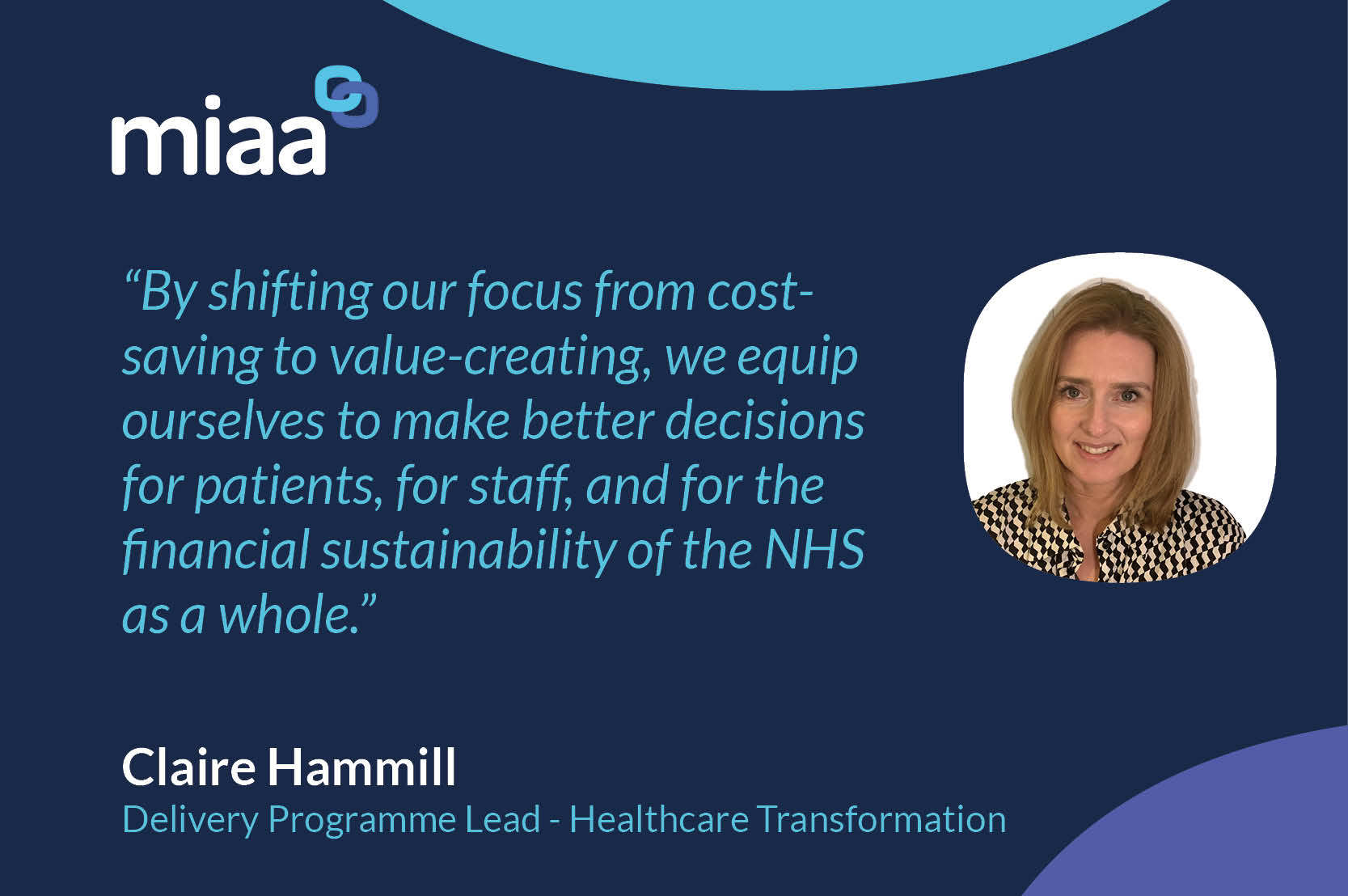
By shifting our focus from cost-saving to value-creating, we equip ourselves to make better decisions for patients, for staff, and for the financial sustainability of the NHS as a whole.
If you want to strengthen your organisation’s value creation, make sustainable improvements and boost productivity safely;
- Book a conversation with our improvement experts
- Access our insights and case studies to see how we support out clients