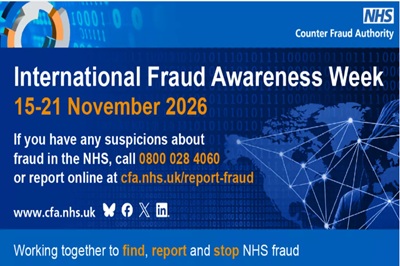
International fraud awareness week 2026: Protecting the NHS from fraud
International Fraud Awareness Week (IFAW) is a global campaign led by the Association of Certified Fraud Examiners (ACFE), bringing organisations together to raise awareness of fraud and the importance of prevention.
The campaign takes place from 15–21 November, with the MIAA using the week as an opportunity to encourage staff to help find, report and stop fraud.
Darrell Davies, Assistant Director commented: "Fraud against the NHS is not a victimless crime. Every pound lost to fraud is money that could otherwise support NHS services and patient care. Last year, the amount of NHS funding vulnerable to loss through fraud, bribery, and corruption in England has been estimated to be £1.3bn. Tackling it depends not only on counter-fraud professionals but also on NHS staff being vigilant and speaking up when something does not look or feel right."
What should NHS staff look out for?
The NHS Counter Fraud Authority's 2026 intelligence assessment identifies NHS staff fraud, patient exemption fraud, procurement and commissioning fraud, and fraudulent access to NHS care by overseas visitors as the four most frequently reported areas. Developing threats also include false qualifications and references and undeclared conflicts of interest.
Staff should be particularly alert to suspicious emails, telephone calls, text messages and other unexpected approaches. Fraudsters can use phishing emails, telephone calls (vishing) and text messages (smishing) to trick people into revealing information or taking actions that compromise security. NHS fraud-awareness material also highlights payment diversion fraud, where phishing can be used to obtain access to accounts and change bank details to divert salary or other payments.
Be cautious if someone unexpectedly asks you to disclose sensitive information or take a financial action. Pause and question the request rather than allowing urgency or apparent authority to influence your judgement.
Concerned about fraud? Speak up
You do not need proof before raising a concern. If something does not seem right, seek advice rather than attempting to investigate it yourself.
If you suspect fraud, bribery or corruption affecting the NHS:
- Speak to your Local Counter Fraud Specialist (LCFS) for confidential advice and guidance. Their contact details should be on your organisation’s intranet or within the Anti-Fraud and Bribery Policy. or, speak to your Director of Finance or Chief Finance Officer.
- Report your concerns through the NHS Counter Fraud Authority's online reporting service.
- Alternatively, call the NHS Fraud and Corruption Reporting Line on 0800 028 4060, available 24 hours a day. You can also choose to report anonymously.
Importantly, don't confront someone you suspect or try to investigate the matter yourself. Provide as much information as you can and let the appropriate counter-fraud professionals assess the concern.
International Fraud Awareness Week is a reminder that we all have a role to play in protecting NHS resources. Stay alert, question anything that does not seem right and raise concerns promptly.
Take a look at our video about fighting fraud in the NHS during International Fraud Awareness Week, and beyond:
Together, we can help protect NHS resources so they are available where they are needed most: supporting services and patient care.